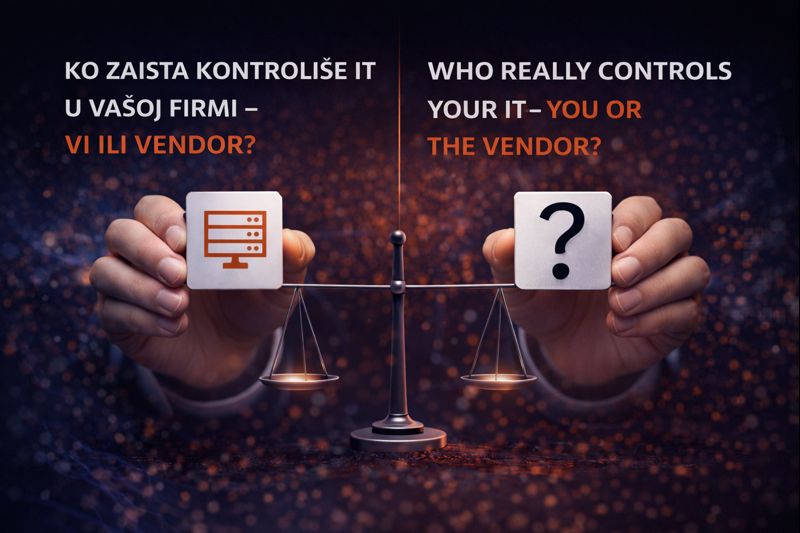

In many small and medium-sized companies, but increasingly in enterprise environments as well, IT has stopped being a strategic advantage. Instead, it has become a dependency – not on technology itself, but on vendors, licenses, closed systems, and people who are "the only ones who know how it works".
This isn't a text against commercial software. This is a text about control, long-term sustainability, and business risk that remains invisible until it's too late.
The Illusion of Functionality
Most IT decisions are made for practical reasons: "It works right away", "Everyone uses it", "We have support". On paper – logical. In practice – companies often end up with systems they don't understand, costs that grow every year, and limitations that only appear when the business needs to scale or change.
Ask yourself honestly: If you lost your IT person or partner tomorrow, how quickly could you continue operating normally?
If the answer isn't "immediately" or "within a few hours", your IT isn't a tool – it's a risk.
Vendor Lock-in: The Most Expensive Silent Problem
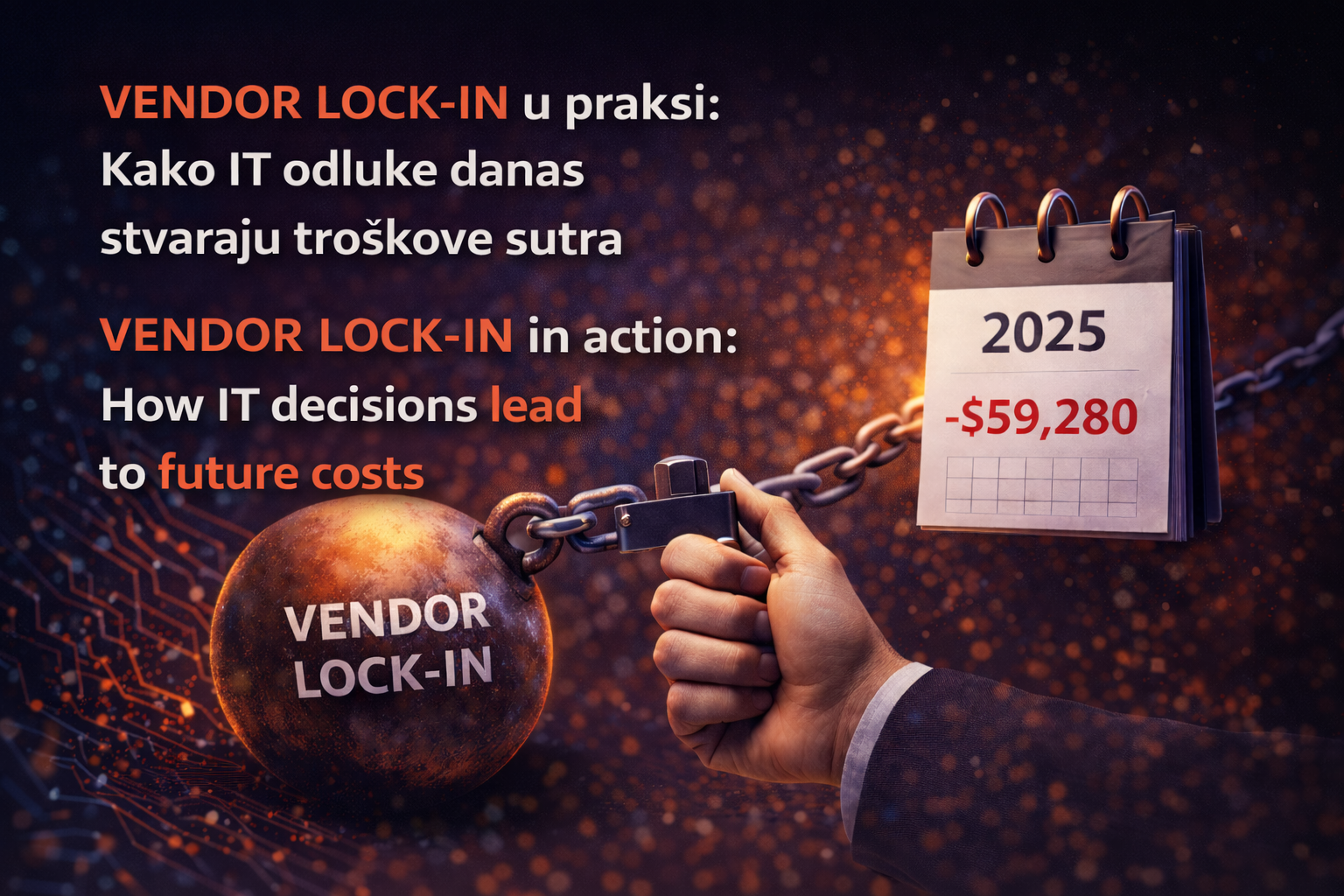
Vendor lock-in doesn't happen overnight. It builds slowly, through proprietary data formats, specific per-user or per-device licenses, software that can't be integrated without additional modules, and contracts that seem harmless while everything goes according to plan.
The problem arises the moment you want to change vendors, integrate a new system, or optimize costs. That's when you realize you don't own your IT – you're its user under someone else's terms.
The worst part? This risk is rarely explained upfront. Only when you try to leave do you realize how expensive the exit door actually is.
Open Source Isn't "Free Software" – It's a Business Model
One of the biggest misconceptions in the IT community is that open source is a solution for hobbyists, enthusiasts, or "those who don't have a budget".
In reality, open source is the foundation of most enterprise systems, the basis of cloud infrastructure (AWS, Google Cloud, Microsoft Azure – all use Linux), and the standard in security, networking, and servers. Banks, telecoms, governments – all rely on open source technologies.
The difference is in one thing: open source gives you a choice. Choice of vendors. Choice of how you'll maintain the system. Choice of how you'll evolve without waiting for someone else to decide what the "next version" is.
It's not free – but it's yours.
Critique and Self-Critique of the IT Community
It's time to say it openly: a large part of the IT community pushes the same solutions, the same stacks, and the same vendors – not because they're always the best, but because it's easier not to think.
It's easier to sell what everyone knows. It's easier to maintain what the vendor dictates. It's easier to hide a lack of knowledge breadth behind an "industry best practice" phrase that means absolutely nothing in the context of your specific business.
But business doesn't pay IT to be comfortable – it pays IT to be sustainable, flexible, and secure.
A question IT professionals rarely ask: What problem are we actually solving, and is there a way to solve it so the client remains in control?
What Does It Really Mean to Have Control Over IT?
Control doesn't mean everything has to be open source. Control means you understand where your data is, who has access and why, how much it costs you to change vendors, and how dependent you are on an individual or company.
Control means that IT serves strategy, not the other way around..
Specifically, this means:
- You can change providers without creating complete chaos
- You can get a copy of all your data in a standard format
- You understand the basic logic of the system even if you don't maintain it yourself
- You know exactly what you're paying for and why
If you can't answer these questions – you don't have control. You have dependency.
Where KRUNA Tech Solutions Comes Into the Picture
KRUNA Tech Solutions doesn't sell templated software, nor do we push "standard solutions" because it's easier.
We work with companies that want stable Linux and open source infrastructure in a business context, a realistic assessment of vendor dependency before it becomes a problem, and IT architecture that can grow, change, and adapt without asking permission from a vendor.
Our focus isn't "what's popular" or "what everyone uses". Our focus is on what's long-term smart for your specific business.
Conclusion: Three Questions You Must Know
- If you don't know how much it costs you to change IT solutions – you're already in trouble.
- If you don't know who has access to your data and under what contractual terms – the risk already exists.
- And if no one explains your IT to you, but only "maintains" it and says "it has to be this way" – it's time for a conversation.
IT should be your growth lever, not a chain around your neck.
Final question: When was the last time you saw the complete architecture of your IT system? If the answer is "never" – it's probably time to change that.