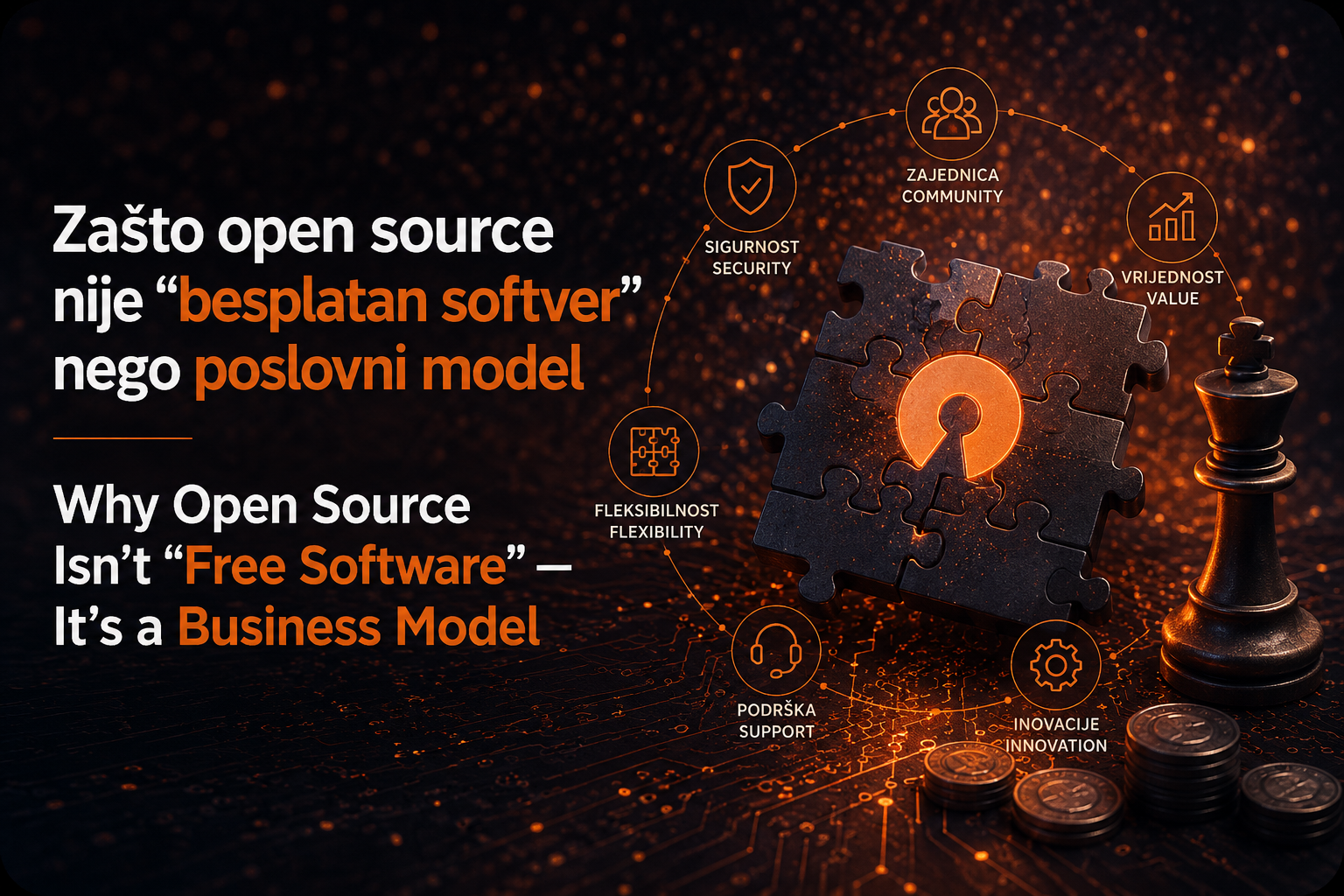

When you hear the term open source, what's the first thing that comes to mind? Probably something like: "That's the free software you can just download and use." You wouldn't be alone. That assumption is so widespread it's become a default, even among IT professionals. But the reality is far more interesting and far more useful for understanding how the modern technology market actually works.
Open source didn't accidentally become profitable. In an increasing number of cases, it's a deliberate growth strategy that uses code transparency as a competitive advantage.
What Open Source Actually Means?
Open source means that a software's source code is publicly available — anyone can inspect it, copy it, modify it, and distribute it, under certain conditions defined by its license. But "available" doesn't automatically mean "free in every sense of the word."
There are three layers of cost that are routinely overlooked:
- Implementation cost — downloading the software is free, but installing it, configuring it, and integrating it into your existing environment costs something — in time, in expertise, or in money paid to specialists.
- Maintenance cost — who applies security patches when they're released? Who monitors changes in the upstream project? Who responds when something breaks?
- Support cost — a community forum is not a service agreement. If your critical application goes down on a Friday night, a GitHub thread is not a solution.
How Companies Make Money From Open Source?
The natural follow-up question: if the code is free, where's the money? The answer lies in what code cannot be free, security, reliability, expertise, and accountability. Here are the proven business models:
1. Open Core: the company releases the "core" of the software as open source, while advanced features — enterprise integrations, enhanced security, team administration — are offered through paid "Pro" or "Enterprise" tiers. Examples: GitLab, HashiCorp, Elastic.
2. Managed Services (SaaS): the code is free, but managing it isn't. Red Hat built an entire business model on absorbing the complexity of Linux from the client and guaranteeing stability. MongoDB, Confluent, and many others sell hosted versions of their open source projects — backed by SLA commitments.
3. Support & Professional Services: organizations without internal capacity pay for expert support, training, and consulting. Canonical (Ubuntu), SUSE, and Red Hat have built decades of revenue on exactly this model.
4. Dual Licensing: the same software is offered under two licenses — one is free for non-commercial use, and a second, commercial license is paid. MySQL is the textbook example: use it freely in your open source project, but integrate it into a commercial product and you're buying a license from Oracle.
5. Ecosystem & Mindshare Strategy: Google, Meta, and Amazon release open source projects — TensorFlow, React, Firecracker — not out of philanthropy, but to build ecosystems, attract talent, and standardize markets in ways that benefit their core business models.
Why This Matters for Your Business?
If you're an entrepreneur, IT manager, or decision-maker, here's the key takeaway: Choosing an open source solution is not a pricing decision — it's a risk and resource decision. When evaluating open source software, the question isn't "is it free?" The right questions are:
- Who is behind this project, and do they have a financial interest in maintaining it?
- Is commercial support available if needed?
- What is the real Total Cost of Ownership?
- Is the license compatible with how we intend to use it?
Popular licenses (MIT, Apache 2.0, GPL, AGPL) carry very different implications for commercial users. AGPL, for example, requires that any software using AGPL-licensed code and distributed over a network must itself be published as open source. That can be a deal-breaker for SaaS companies.
Open Source as a Market Signal
There's one more reason companies publish open source code that often goes unnoticed: trust. In the B2B segment — especially in hosting, cloud, and security — code transparency is an increasingly powerful trust signal. Clients want to know what's happening under the hood. Audit trails. The ability to review code themselves. Independent verification of security claims. This is especially true for companies offering hosting services — a segment where trust is built over years and lost in minutes.
Conclusion
Open source is one of the most sophisticated business models in the modern technology market. It's neither altruism nor amateurism, it's a strategy through which billion-dollar companies build market dominance, attract talent, and create user loyalty.
The next time someone says "we use open source, so it's free" — you'll know exactly what to say.
*If you have questions about open source solutions for your hosting or infrastructure needs? Feel free to reach out.